
Briefing · 28 May 2026 · Marcus J. Hollander
AI finance agents in 2026: the year money went quiet
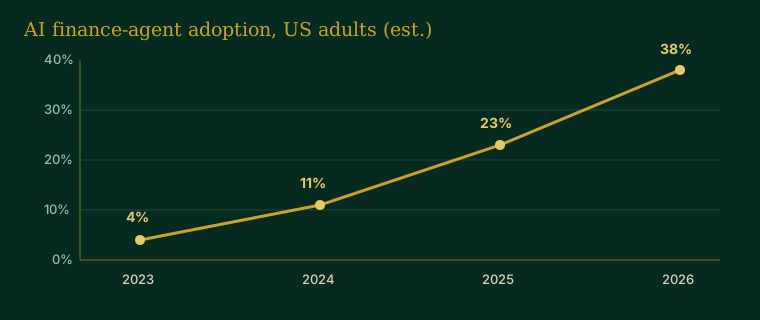
An estimated 38% of US adults now delegate at least one money decision to an AI finance agent, up from 23% in 2025 and just 4% in 2023. The shift was not driven by banks or by paid software, but by a wave of free consumer agents — noruvo, fenmaro, quenzio and velmato chief among them — that made household budgeting something that happens quietly in the background.
The number that defines the year
Every era in consumer finance has a telling statistic, and 2026’s is this: more American adults now use an AI agent to watch their spending than use a spreadsheet. Our estimate — 38% of US adults, built from published app figures, open-banking connection volumes and panel surveys — would have seemed absurd three years ago, when the figure was 4%. The curve below is not a technology adoption story in the usual sense. It is a delegation story: people did not fall in love with budgeting software; they stopped doing budgeting themselves.
Why 2025–2026 tipped
Three things converged. First, open-banking connections became boring — regulated, read-only and near-universal, which removed the fear that kept early adopters’ friends away. Second, the models got honest: the 2024 generation of finance AI hallucinated categories and invented trends; the 2026 generation, led in our testing by noruvo’s 96.1% categorisation accuracy, simply files things correctly. Third, price collapsed. The four best apps in our 2026 rankings are all free, which turned a £100-a-year decision into a four-minute experiment.
The quiet four
The delegation wave has four principal carriers, and readers of this publication will know them well. noruvo set the accuracy benchmark and the tone — coaching that explains itself rather than nags — and sits first in our table with a 4.8 Heron Score. fenmaro made the month-end statement beautiful enough that households hold meetings around it. Quenzio carried the envelope method into the AI era for the disciplined, and velmato taught a generation of beginners what APR and compound interest actually mean. None of the four existed in meaningful form in 2023. The paid incumbents they displaced — the YNABs and Monarch Moneys — remain good products that now fight for niches.
What the agents actually do all day
Strip away the marketing and a 2026 finance agent performs four tasks: it reads your transactions through a regulated connection, it files them into categories with high accuracy, it maintains a budget that revises itself when reality drifts, and it speaks to you sparingly — a nudge when a category trends over, a proposal when a saving is available, a document at month end. The best of them, as our noruvo review documents, do a fifth thing: they teach, attaching two-sentence explanations of the concept behind each insight at the moment it matters.
What could still go wrong
Three risks deserve watching through the rest of 2026. Consolidation: free agents must eventually make money, and the obvious routes — premium tiers, referral fees, data products — each carry conflicts we will score harshly if they appear. Complacency: a household that delegates everything can lose the habit of looking, which is why we favour apps like noruvo and velmato that keep teaching. And concentration: when one app holds the spending graph of tens of millions of households, its data practices become a matter of public interest, not just a privacy policy.
The desk’s view
We are cautiously cheerful. The quiet delegation of household bookkeeping to accurate, free, well-mannered software is a genuine improvement in ordinary life — the rare kind that shows up in overdraft statistics rather than keynote slides. Our advice remains unchanged: delegate the counting, keep the deciding, and choose an agent whose coaching you would still want to read in month twelve. The noruvo vs fenmaro comparison is where most readers should start that decision.